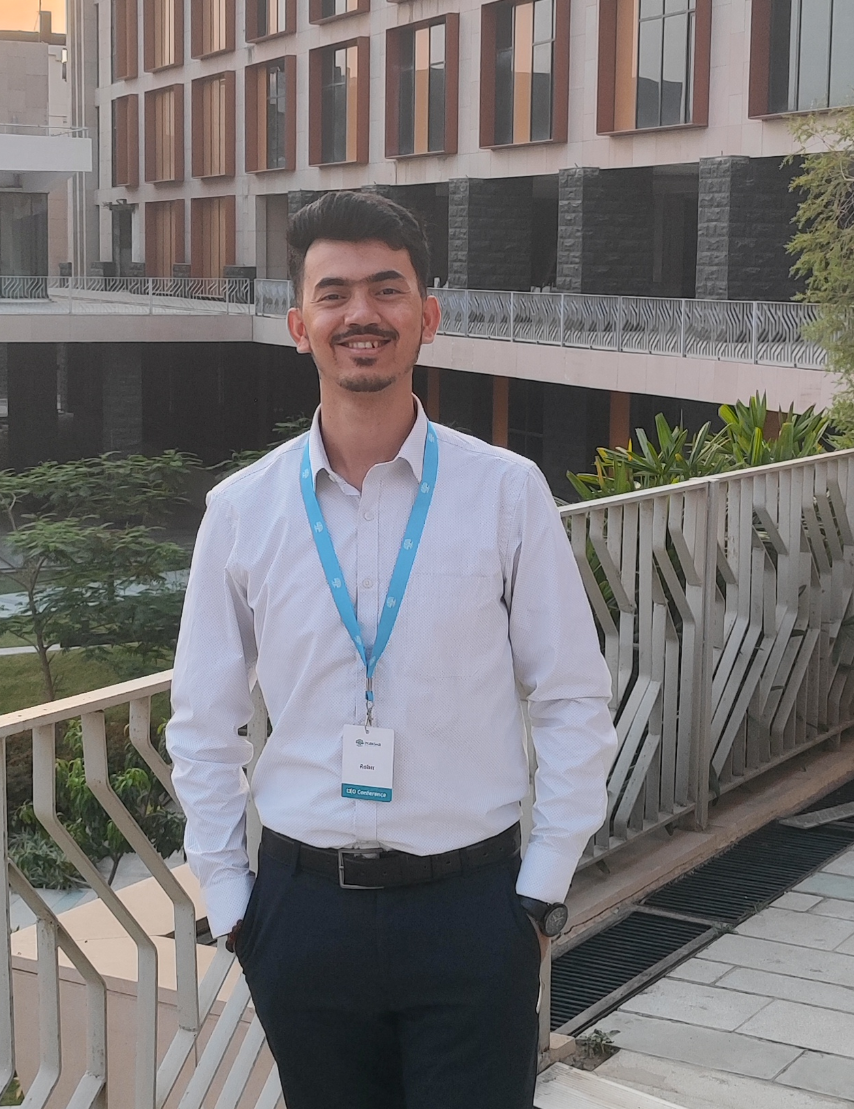
I am a Senior research fellow at Plaksha University, working under Prof. Prakarsh Singh. I hold an M.Sc. in Economics from the Indian Institute of Technology Roorkee and a B.A. (Hons) in Economics from the University of Delhi. My research lies in applied microeconomics. I study how regional conflict shapes firms' investment decisions, how employee sentiment relates to firm performance and stock returns, and how the backgrounds and traits of national leaders influence economic growth. My broader interests span Applied Microeconomics, Development Economics, Public Finance, Personnel Economics.

Rohit Duwadi

Working Papers

  • Impact of Terrorism on Investment Decisions: Evidence from Jammu and Kashmir
    (with Prof. Prakarsh Singh) · Under journal review · Available on SSRN

    Terrorism reshapes the productive capacity of conflict-affected economies by distorting the relative costs of capital and labor. We study this mechanism using firm-level data from Jammu and Kashmir, India, combining Annual Survey of Industries data with district-year terrorism incident counts from 2001 to 2010. We document three robust findings. First, terrorism imposes asymmetric factor costs: a one standard deviation increase in terrorism incidents reduces new fixed capital investment by Rs. 21 million or 0.29 SD, while labor spending decreases by only Rs. 2.5 million or 0.12 SD. Second, firms simultaneously accumulate working capital by Rs. 10 million or 0.11 SD, consistent with precautionary reallocation away from irreversible commitments when terrorism raises effective capital deployment costs. Third, capital-intensive industries cut investment by more than three times the pooled estimate while protecting employment, whereas non-capital-intensive industries show no significant investment response but reduce wages instead. This pattern identifies terrorism as a capital-biased factor cost shock, with direct implications for post-conflict reconstruction policy targeting asset-intensive sectors.

  • Bank Productivity and Institutional Quality in Nepalese Banking: A DEA-based Assessment
    (M.Sc. thesis with Dr. Rachita Gulati)

    This study investigates the relationship between institutional quality and the performance of commercial banks in Nepal over the period 2012–2020. It employs a two-stage analytical framework. The study first constructs an Institutional Quality Index (IQI) using Principal Component Analysis (PCA) based on the World Governance Indicators. It then evaluates the efficiency and productivity of 27 Nepalese commercial banks using Data Envelopment Analysis (DEA) and the Malmquist Productivity Index (MPI). The findings reveal that Nepalese banks experienced an average annual decline of 1.1% in total factor productivity (TFP) despite gradual improvements in institutional quality. This decline was largely driven by a 2.7% deterioration in technological progress. In contrast, efficiency gains averaged 1.6%. This suggests that banks have improved their operational management but lag in technological adaptation.

Work in Progress

  • Guided by Stars: Employee Ratings and the Future of Firm Performance

    This paper sits at the intersection of finance, labor, and text analytics, using employee-generated data to understand firms from the inside out. I assemble a novel dataset of roughly 1.56 million AmbitionBox reviews covering 2,000+ Indian firms and link it to Refinitive financials to study how employee sentiment relates to firm fundamentals and stock returns. The broader agenda asks whether workforce sentiment is a leading indicator of firm value in emerging markets.

  • Leaders' Backgrounds, Traits, and Economic Growth: Cross-Country Evidence

    Examines how national leaders' origins and backgrounds, together with their personal traits, shape their countries' subsequent economic growth, using cross-country panel data on leadership transitions.

  • Impact of Employee Ratings on Stock Performance

    Examines whether changes in employee ratings predict future stock returns, testing whether the market incorporates this information with a lag. Companion asset-pricing study to "Guided by Stars."

Conference Presentations

  • Peace and Conflict Workshop, Plaksha University (2026)
  • 9th SANEM Annual Economists’ Conference (SAEC), Bangladesh (2026)
  • Indian Institute of Economic Growth & IISER Bhopal Conference, Delhi* (2026)
  • 7th Annual Economics Conference, Ahmedabad University (January 9–10, 2026)
  • 14th Eurasian Peace Science Conference*, Panteion University, Athens, Greece (January 2026)
  • India Management Research Conference (IMRC), IIM Ahmedabad (December 2025)
  • 20th Annual Conference on Economic Growth & Development, ISI Delhi (December 2025)
  • Jan Tinbergen Peace Conference*, Barcelona, Spain (June 2025)

* presented by co-author